
The Wedding Went On
Love, sirens, canceled flights, and one very Israeli wedding

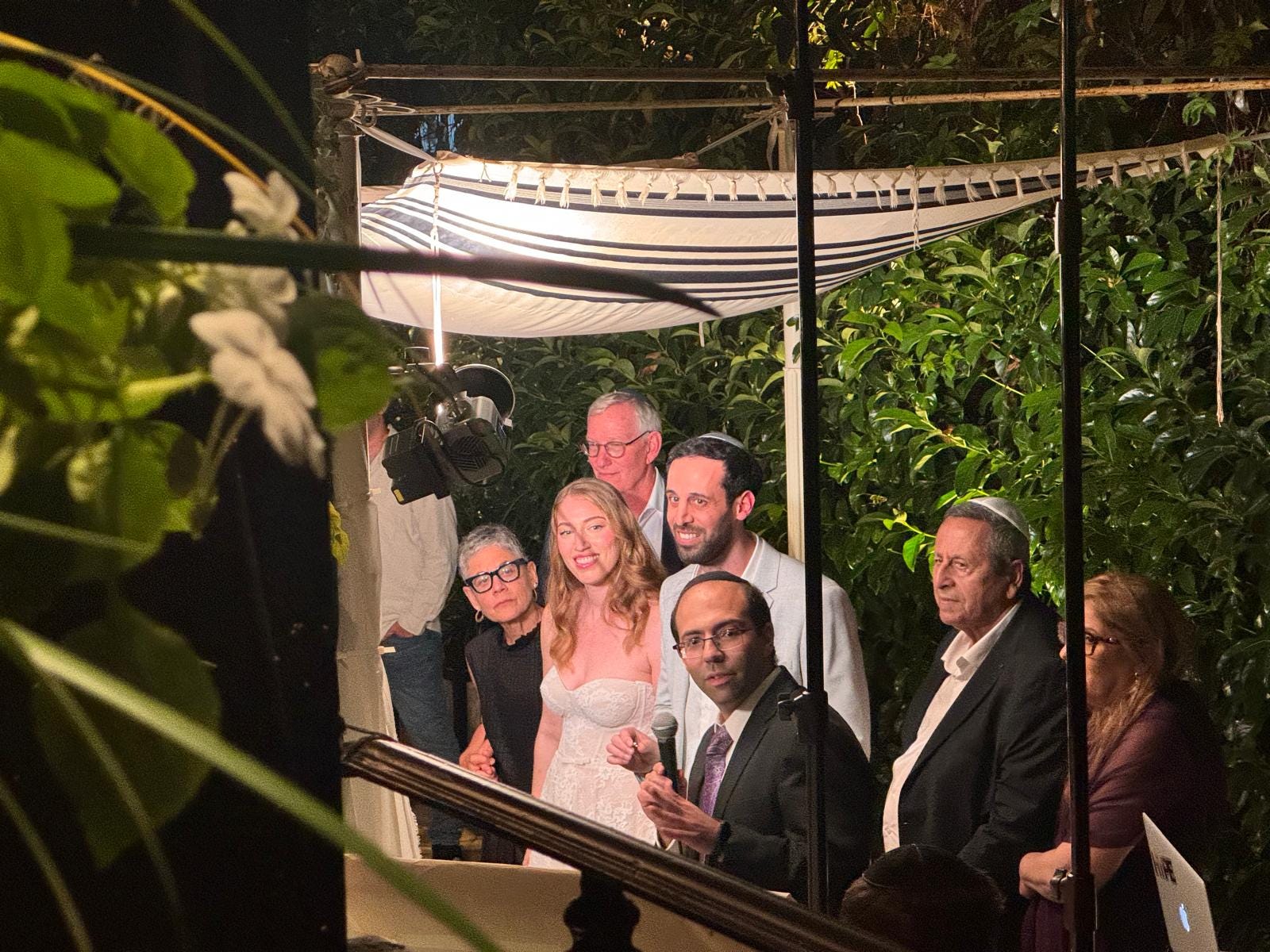
The wedding went on against all odds
We can finally exhale.
Charlotte and Shay got married this weekend in Tel Aviv, and as I write this, I am recovering from equal parts emotional exhaustion, dance floor abuse, and approximately seventeen too many celebratory shots.
To be honest, I’ve avoided posting much about the wedding online these past few months. Call it superstition. Call it Jewish trauma. Call it not wanting to tempt the ayin hara, the evil eye, the kenahora jinx.
Because until very recently, we genuinely did not know if this wedding was even going to happen.
For the 74 days leading up to the wedding, we lived in a strange suspended state somewhere between celebration and crisis management.
Flights from the U.S. were canceled.
Sirens continued to sound.
Missiles and rockets continued to fall.
Government restrictions limited gatherings.
Every few days there was a new escalation, a new rumor, a new reason to wonder if we should start preparing for postponement.
Then suddenly, a temporary ceasefire.
But would it hold?
Planning this wedding felt a little like planning a wedding in Buffalo when the forecast suddenly changes to a massive blizzard three days before the event.
Except instead of nervously checking the weather for 72 hours, we were holding our breath for over two months.
And yes, before I go any further, let me say this clearly:
I fully understand how small and privileged our stress sounds compared to families who lost loved ones, wounded soldiers, displaced families, and people carrying grief far heavier than wedding anxiety.
Our stress pales in comparison.
But it was still real.
Most days since October 7 have felt like living on a roller coaster nobody can get off.
One day you feel hopeful.
The next day you feel like you’re drowning.
One day life feels almost normal.
The next you’re standing in a stairwell or bomb shelter checking Telegram updates while trying to calculate how far away the interception sounded.
And then somehow, in the middle of all of that:
you have a wedding.
In Jewish tradition, weddings are considered profoundly life-affirming events, especially during periods of tragedy and uncertainty.
Maybe even acts of defiance.
There’s a well-known Jewish teaching that if a wedding procession and a funeral procession meet, the wedding goes first, symbolizing the obligation to choose life and continue forward.
During this war, there were countless stories of weddings taking place in bomb shelters, underground parking garages, and evacuation hotels.
Because life here does not pause neatly for history.
People still fall in love.
Families still gather.
Glasses are still broken beneath the chuppah.
And eventually, after weeks of anxiety, ours did too.
The wedding took place along the coast in Tel Aviv, Israel’s vibrant, chaotic, cosmopolitan White City.
It felt completely different from our other daughters’ weddings in the hills outside Jerusalem, where the backdrop was mountains, stone, and pine trees.
This one felt unmistakably Tel Aviv.
Warm Mediterranean air.
Music thumping.
People spilling onto the dance floor before dinner was even served.
Israeli weddings are next level.
Partly because Israelis know how to celebrate.
And partly, I suspect, because living with uncertainty makes people appreciate joy differently.
The ceremony itself took place under the chuppah, the wedding canopy, with guests gathered closely around the couple rather than seated quietly in rows.
And then came the dancing.
Israeli wedding dancing is less “formal reception” and more “contained public uprising.”
Circles.
Singing.
Sweat.
Chaos.
Shots appearing magically in people’s hands every seven minutes.
And the dress code?
This is Israel.
Some guests were elegantly dressed.
Some looked like they came directly from the beach.
I’m pretty sure at least one person was wearing sneakers they also use for gardening.
Israeli weddings operate on a very simple principle:
Did you come?
Did you dance?
Then, you’re appropriately dressed.
Toward the end of the ceremony, Shay smashed the traditional glass beneath his foot.
The custom serves as a reminder that even at moments of greatest joy, Jews remember sorrow, particularly the destruction of the ancient Temple in Jerusalem.
This year, though, the shattered glass carried additional meaning.
It reminded us of everyone who could not be there.
Friends whose flights never made it.
Family who stayed behind because of the war.
And especially my mom back in Memphis, who desperately wanted to come but simply could not.
And yet somehow, despite everything, the wedding happened.
For one evening, people stopped checking the news alerts.
They stopped talking about interceptions and ceasefires and canceled airlines.
They danced.
They laughed.
They celebrated life.
And honestly, after these past months, that may have been the most Israeli thing of all.
Mazel Tov! This is beautiful.
Mazel Tov on this very special wedding celebration! You beautifully described the joys of an Israeli wedding and we’re so thrilled that all went off without a hitch. So sorry your Mom wasn’t able to attend but I’m sure her heart was with you all.